
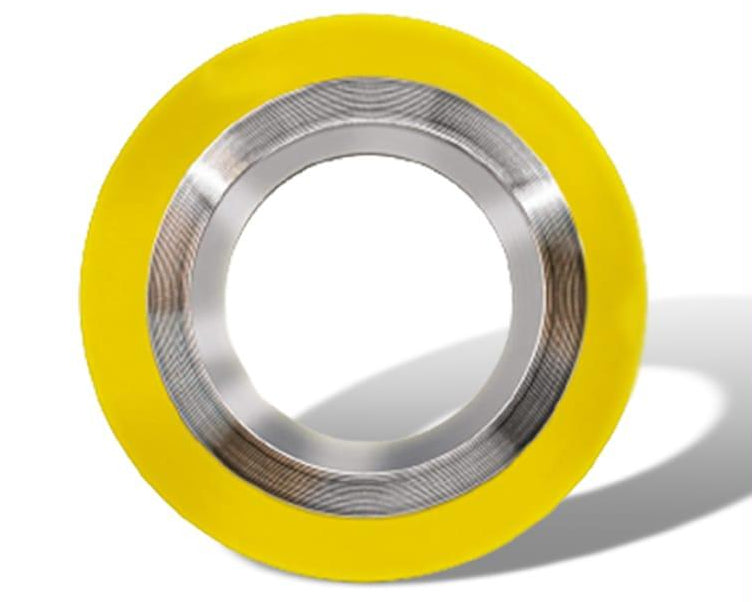
Both seal a flange, and on paper both will hold. That is why the question keeps coming up. The honest answer is that they fail in different ways, and the one you want is decided by the flange and the duty, not by which is the better gasket.
A graphite sheet gasket is cut from flat material. A spiral wound gasket is a manufactured ring, wound to a fixed size. That single difference drives almost everything else — what you can make on site, what each costs, what happens when the bolts relax, and which one you can actually get hold of on a Tuesday afternoon.
What is the short answer?
Use a graphite sheet gasket for standard-pressure flanges, odd shapes and anything you need cut to size. Use a spiral wound gasket for class 300 and above, for high-temperature pipework, and anywhere thermal cycling will loosen the bolts. If the joint is a class 150 water or process line on a reasonably flat flange, sheet is usually the right call and the cheaper one. If it is a steam line, a compressor connection or a flange that heats and cools every day, the spiral wound is worth the money.
What is a graphite sheet gasket?
A graphite sheet gasket is a flat gasket cut from flexible graphite foil, either pure or reinforced with a stainless steel insert. Our pure graphite sheet runs from −195°C to 450°C, and up to 650°C in steam, and meets the ASTM F607 fire-safety requirement. The reinforced grades add a 0.1 mm AISI 316 stainless insert — tanged or flat — which raises the surface load the sheet will take and makes blow-out far less likely. The tanged material meets DIN 3535-6 for leakage.
Sheet comes in thicknesses from 0.5 mm to 5 mm in 1000 × 1000 mm and 1500 × 1500 mm sizes, so a gasket can be cut to any shape: a non-standard flange, a pump housing, a hand-hole cover, a one-off repair nobody has a drawing for.
What is a spiral wound gasket?
A spiral wound gasket is a pre-made ring built from alternating layers of metal strip and soft filler, wound in a spiral and held by an outer centring ring. Ours use an SS316L winding with a flexible graphite filler and an epoxy-coated carbon steel outer ring, manufactured to ASME B16.20.
The reason it exists is recovery. The wound construction behaves like a spring: when the flange heats, cools and the bolts relax, the gasket pushes back and keeps some load on the seal. A flat sheet cannot do that to the same degree. That is the property you are paying for, and if the joint never cycles you may not need it.
Graphite sheet vs spiral wound: a direct comparison
| Graphite sheet gasket | Spiral wound gasket | |
|---|---|---|
| Form | Cut from flat sheet | Pre-made ring, fixed sizes |
| Typical duty | Class 150, standard pressure | Class 300 and above, high pressure |
| Thermal cycling | Relaxes and may need re-torquing | Springs back, holds bolt load |
| Shapes | Any shape, cut to size | Round flanges only |
| Standard | ASTM F607 / DIN 3535-6 | ASME B16.20 |
| Flange condition | Tolerates worn or pitted faces | Needs a sound, flat face |
| Cost | Lower | Higher |
When should you use a graphite sheet gasket?
Choose graphite sheet when the flange is standard pressure, an odd shape, or in poor condition. It suits class 150 pipework, pump and valve covers, older cast flanges that are no longer perfectly flat, and any joint where you need the gasket cut to a shape nobody stocks. It is also the practical choice when you need something today: sheet can be cut while you wait, where a spiral wound has to be the right size or it is no use at all.
If the flange is worn, pitted or non-parallel, sheet is not the compromise — it is the correct answer. A spiral wound gasket needs a sound face to seat against.
When should you use a spiral wound gasket?
Choose a spiral wound gasket for high pressure, high temperature, and joints that cycle. Steam lines, compressor and turbine connections, class 300 and above flanges, and anything on a plant that heats up and cools down daily are all cases where a flat sheet will slowly lose bolt load and start to weep. The wound construction keeps pushing back as the joint moves.
The trade-off is that it must match the flange exactly — correct bore, correct outside diameter, correct pressure class. There is no cutting one down.
GR or GRI: does the gasket need an inner ring?
Use GRI — the style with an inner ring — for class 300 and above, high pressure, and small-bore flanges. The inner ring supports the graphite filler against inward blow-out, which is the failure mode that matters as pressure climbs. GR, with no inner ring, is intended for class 150 and standard-pressure connections such as general process, utility and water pipework.
If you are unsure, the pressure class on the flange decides it. Class 150, GR is fine. Class 300 or higher, specify GRI.
What about gland packing on farm pumps?
Gaskets seal a flange; gland packing seals a rotating or reciprocating shaft, and it is a different decision. For most agricultural water duties graphite cotton packing is the sensible starting point, running from −20°C to 120°C, up to 50 bar and 8 m/s shaft speed across a pH range of 4 to 10. For slurry and mild abrasives, flax packing impregnated with PTFE is the cost-effective choice. For sprayers and agrochemicals, pure PTFE handles the full 0–14 pH range.
Whatever you fit, measure rather than guess: you need the shaft diameter and the bore of the stuffing box, and the cross-section is half the difference between them. A fuller guide to sealing farm pumps and equipment follows shortly.
Still not sure?
Send us the flange or the pump. Pressure class, size, what is going through it and how hot it gets is usually enough for us to tell you which way to go, and whether you need a spiral wound at all. A good number of enquiries end with us saying the cheaper sheet gasket is the right answer.