
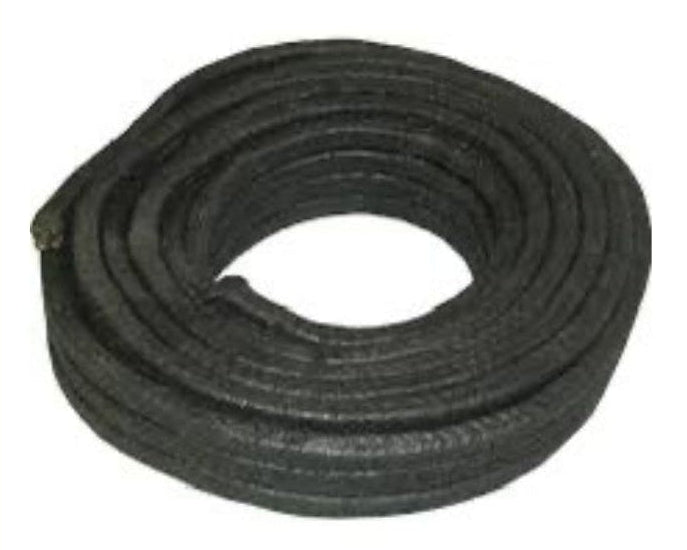
Farms get through gland packing. Irrigation sets that run flat out for a fortnight then sit all winter, slurry pumps handling something deliberately abrasive, washdown gear that never quite dries, sprayers pushing chemicals through a shaft seal. All of it is hard on packing, and most of it is running the wrong grade because whatever was on the shelf went in last time.
The duties are more distinct than they look. Getting the material right is not complicated, but it does mean treating irrigation and slurry as separate problems rather than both as water.
What is the short answer?
For clean or dirty water, use graphite cotton packing. For slurry and mild abrasives, use flax impregnated with PTFE. For sprayers and anything chemical, use pure PTFE. If one pump has to do more than one of those jobs, go up to the more demanding material rather than splitting the difference.
What does gland packing actually do?
Gland packing is a braided rope seal, cut into rings and packed into the stuffing box around a shaft. Tightening the gland nuts compresses the rings outward against the bore and inward against the shaft. It is a controlled leak, not a dry seal — the small amount of liquid that passes is what lubricates and cools the packing.
That last point causes more failures on farms than any material choice. A gland nipped up until it stops dripping has no lubrication, so it runs hot, glazes, hardens and scores the shaft. A few drops a minute is correct.
Which packing for which farm duty?
| Duty | Packing | Rating |
|---|---|---|
| Irrigation, water transfer, washdown | Graphite cotton | −20°C to 120°C, 50 bar, 8 m/s, pH 4–10 |
| Slurry, dirty water, mild abrasives | Flax with PTFE | General duty, rot resistant |
| Abrasive or high-wear duty | Aramid (Kevlar) with PTFE | Up to 250°C, 200 bar on valves, pH 2–12 |
| Sprayers, agrochemicals, fertiliser | Pure PTFE | Up to 280°C, pH 0–14 |
Irrigation, water transfer and washdown
Graphite cotton packing is the straightforward choice for water. It runs from −20°C to 120°C, up to 50 bar and 8 m/s shaft speed, across a pH range of 4 to 10, which comfortably covers borehole water, river abstraction, mains and the sort of dirty water a yard washdown pump sees.
It is also the sensible swap if you are re-packing an older pump. A lot of farm equipment still has graphite asbestos packing in it; graphite cotton is a non-toxic, asbestos-free replacement that goes into the same stuffing box.
Slurry, dirty water and abrasives
Flax packing impregnated with PTFE is the cost-effective option for slurry work. Long-fibre flax resists rot, which matters on equipment that sits wet between jobs, and the PTFE and lubricants reduce friction on both rotary and reciprocating pumps. It is a general-duty packing and priced like one.
Where the duty is genuinely punishing, or where shaft life is the real cost rather than the packing, aramid (Kevlar) fibre with PTFE is the more durable choice. It runs from −100°C to 250°C, up to 200 bar on valves, across a pH range of 2 to 12, and is specified where strength and durability are the deciding factors.
Abrasives do not usually destroy the packing first. They embed in it, and the packing then works like a file on the shaft. If you are replacing shafts or sleeves rather than packing, move up a grade.
Sprayers and agrochemicals
Use pure PTFE. It operates from −100°C to 280°C, handles the full 0–14 pH range, and resists nearly all chemicals apart from alkali metals and gaseous fluorine. That covers agrochemicals, liquid fertiliser and cleaning agents without you having to check each product against a compatibility chart.
Where a sprayer pump also runs hot or fast, PTFE infused with graphite is worth considering instead: the graphite lowers friction and reduces sleeve wear, and it is rated to 25 m/s.
How do you measure gland packing size?
Measure the shaft diameter and the bore of the stuffing box. The packing cross-section is half the difference between the two. A 40 mm shaft running in a 56 mm bore needs an 8 mm cross-section.
Do not measure the old packing. It has been compressed, heated and distorted in service, and it will read undersize — which is how a pump ends up with packing that never seals properly no matter how hard the gland is tightened.
How to re-pack a farm pump without ruining the shaft
Get every ring of the old packing out, including whatever is welded into the bottom of the box. This is where shafts get damaged, because a screwdriver is the wrong tool and it is usually the tool to hand. A packing extractor set with hooks and corkscrew picks pulls the old rings out without scoring the bore or the shaft.
Then cut the new rings square, not at an angle, and fit them one at a time. Stagger the joints so each ring meets the next at roughly 90 degrees rather than lining the joints up into a channel straight through the gland. Seat each ring properly before the next goes in.
Tighten the gland finger tight, run the pump, then take it down gradually until you have a slow drip. Do not chase a dry gland. Come back after an hour and adjust again, because packing beds in.
Most premature leaks on farm pumps come from fitting, not from the material. Lined-up joints, rings cut short, a gland tightened solid on the first pass — those account for far more failures than the wrong grade of packing.
Still not sure?
Tell us the shaft diameter, the stuffing box bore, what the pump is moving and roughly how fast it runs. That is enough for us to tell you the cross-section and the grade, and to say whether the packing is actually your problem or whether the shaft has gone.