
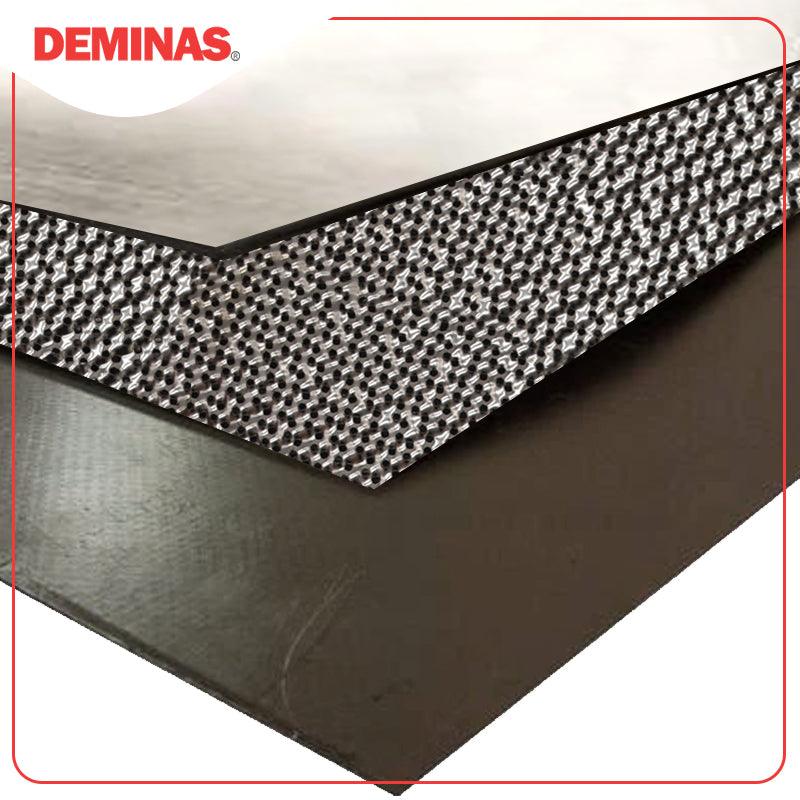
Most enquiries about gasket sheet open with a thickness. Can you cut me a 3mm graphite gasket? It is a reasonable way to ask, but it starts at the wrong end. Thickness is not really something you choose. It is something you arrive at, once you know what the flange looks like and what the joint has to hold.
Get that order right and the sheet almost specifies itself. Get it wrong and you can fit a perfectly good gasket, in the correct material, that weeps within a fortnight.
Start with the flange, not the sheet
Three things decide the answer, and the pipe size is not one of them.
How flat and how clean the faces are. A well-machined raised-face flange on a pump housing asks very little of a gasket. The faces are nearly sealing on their own, and the gasket only has to fill the microscopic roughness left by the tool. A pitted, painted, twenty-year-old cast flange on a water main is a different job: there the gasket has to bridge real damage, and it needs material to do it with.
How much bolt load is available. Sealing is a question of stress, not force. The same bolts that comfortably seat a thin gasket may not develop enough stress to seat a thick one, because a thicker gasket needs more compression to reach the same seating stress. Undersized or corroded bolting, or a flange you cannot fully torque because of access, pushes you toward thinner material rather than thicker.
What the joint is holding. Pressure, temperature and the medium set the material. They also cap how thick you can sensibly go, because internal pressure acts on the exposed edge of the gasket and tries to push it out of the joint.
Use the thinnest sheet the flange faces will tolerate. A thin gasket needs less bolt load to seat, relaxes less in service, and is far less likely to blow out.
Thickness against surface finish
Graphite conforms well, but it cannot fill what it cannot reach. As surface roughness and damage increase, the sheet has to be thick enough that once it is compressed, there is still material bridging the peaks and troughs with something to spare. A useful starting point, assuming the material itself suits the duty:
| Thickness | Flange condition | Typical duty |
|---|---|---|
| 1.0 mm | Machined, flat, clean | Pumps, valve covers, instrument connections |
| 1.5 mm | Good, light scoring | General process and steam pipework |
| 2.0 mm | Worn or lightly pitted | Older plant, cast flanges |
| 3.0 mm | Distorted or non-parallel | Last resort, low pressure only |
Treat 3.0 mm as a repair, not a specification. If a joint needs it, something about the flange is wrong, and the thick gasket is buying time rather than fixing the cause.
Why thicker is usually worse
Reaching for a thicker sheet because a joint keeps weeping is one of the most common mistakes we see, and it usually makes the leak worse rather than better. There are three reasons.
Creep relaxation. Every gasket loses some bolt load after installation as the material relaxes under compression. The more material there is, the more there is to relax, so a thicker gasket sheds proportionally more of the load that was holding it shut. That is why a joint can pass a pressure test and start weeping a week later.
Seating stress. Achieving a given stress on a thicker gasket takes more compression, and therefore more bolt load. If the bolting cannot deliver it, the gasket never seats properly no matter how carefully it is fitted.
Blowout resistance. A thicker gasket presents a larger exposed edge to the internal pressure, and gives the medium a longer path to creep along. Both reduce the pressure the joint will hold.
If a thin gasket is leaking on a flange in good condition, the fault is nearly always the flange faces or the bolting, not the gasket thickness.
Bolting matters as much as the sheet
A gasket only seals because it is being squeezed. Most of the leaks we get called about are installation problems rather than material problems: bolts tightened in the wrong order, tightened in one pass, reused when they had stretched, or torqued against dry, galled threads so that most of the effort went into friction rather than clamping load.
Tighten in a crossing pattern, in stages, working up to the final figure rather than going straight to it. Re-check after the joint has been through its first heat cycle, because that is when relaxation shows up.
Cut-to-size, and what we need to know
If you are having gaskets cut rather than buying standard sizes, the useful information is: flange size and pressure rating, the medium and its temperature and pressure, and a photograph of the faces. That is normally enough to specify both the material and the thickness. A drawing or DXF is better still, and an old gasket or a cardboard template works perfectly well for a one-off.
If you are not sure what condition the faces are in, say so. It changes the answer more than anything else on the list.